Today
we pause to remember the seven men assigned to B-52 (Project Delta) who
were lost on January 29, 1966 in the An Lo Valley. Binh Dinh Province
12 miles west of Tam Quan, South Vietnam. The An Lao Valley was long
and narrow with rice fields interspersed with patches of tall elephant
grass. Heavily forested mountains rose up on either side of the valley.
At the time, B-52 was led by MAJ “Charging” Charlie Beckwith. The three
recon teams inserted suffered so many injuries, Delta was temporarily
out of business. Charging Charlie was also wounded while flying overhead
in his command chopper, but he survived.
Delta's mission was to support the 1st Air Calvary Division with RT's. TAOR was in the northern end of the An Lao Valley. RT's were to observe the main routes leading into the area to determine if VC or NVA were using them to reinforce or to withdraw from US Marines pushing south toward the valley and the 1st Cav and ARVN pushing north.
Intelligence was from unconfirmed agents, weather was terrible, limiting air support and communications, and it was common knowledge that bad guys controlled the valley, 1958 being the last time a friendly unit had operated in this area. Everything looking negative, Delta staff decided to brief the RT's and ask for volunteers. Three teams, 17 men total, volunteered and were infiltrated at last light, 27 January 1966. Five would be killed, three wounded and two reported MIA. The following is a list, from official sources, of those men:
TEAM One: SFC Henry A Keating; SFC Robert P Whitis; SSG Norman C Dupuis (WIA); SSG Agostino Chiariello and SSG Brooke A Bell.
TEAM Two: SFC Frank R Webber (WIA); SFC Marline C Cook (KIA); SSG Donald L Dotson (KIA); SSG Geore A Hoaglund (KIA); SFC Jesse L Hancock (KIA); and SSG Charles F Hiner (WIA).
Team Three: SFC Marcus L Huston; SSG Billy A McKeithe; SSF Wiley W. Gray; SSG Ronald T Terry (MIA); SFC Cecil Joe Hodgson (MIA) and SSG Frank N Badolati (KIA)
At 0930 on the 28th, Team One made contact resulting in 1 VC killed, 2 VC wounded, 1 American wounded (Norman C. Dupuis).
Team Three also made contact on the 28th at 0930 and again at 1205, when SSG Badolati was struck in the upper left arm by a bullet that severely mangled, and nearly severed, his arm. SFC Hodgson immediately applied a tourniquet just before the patrol broke contact. The Americans moved approximately 600 meters before stopping to treat Frank Badolati's arm. As soon as the patrol stopped, it was attacked again. The team immediately returned fire and then separated into two groups of three to attempt to evade the enemy. SFC Marcus L Huston and SSG Billy A McKeithe remained with SSG Badolati. Throughout the rest of the afternoon and night, they cared for Frank Badolati while painstakingly moving through the rugged terrain as they evaded the VC. Periodically they would stop to adjust SSG Badolati's tourniquet. When they would loosen it, the mangled arm began bleeding profusely again.
In the darkness, they came to a streambed that flowed westward from the Song An Lao River. The Americans entered the stream and used it to hide their trail. Finally SSG Badolati stated to the others that he "could not go any further" and for them to leave him behind. The other soldiers selected a position two to three feet up the bank that was well concealed with shrubs and boulders. The three men remained in place from 0300 hours to 0515 hours. During that time, both men administered medical attention to Frank Badolati's mangled arm, however, his condition continued to deteriorate. They believed he died in the early morning of 29 January 1966. After his death, they were forced to leave Frank Badolati's body hidden in the boulders and scrubs as they continued to evade the VC. Huston and McKeithe were exfiltrated by helicopter later that day.
The second group of three,SSG Wiley W Gray, SFC Cecil A Hodgson and SSG Ronald T Terry, evaded for the rest of the day (28th). On January 29, they moved at first light into a defensive position, whereupon they encountered enemy forces and another firefight ensued. Terry indicated that he had been hit, and others thought he had been killed. When they looked for Hodgson, he was gone. He was last seen with 9mm pistol in tall grass within arm’s reach of Gray and Terry, when they opened fire on a hostile element blocking their escape and became separated. Survivors heard additional shots, which they believed were shots fired at Hodgson, and they believed he also had been killed.
The team could not search for Hodgson because of the heavy enemy activity, and were forced to move to a rallying point. They evaded capture for the remainder of the day, and were ultimately picked up by helicopter. Searches for all three missing were conducted for the next 4 days with no results. Hodgson was classified Missing In Action. Badolati and Terry were classified Killed/Body Not Recovered.
Team 2 member Charles 'Chuck' Hiner tells the story of his team.
“The team was inserted into the An Lo Valley at last light on 27 January 1966. Two wet days later -- it was raining hard -- my six-man team was sitting down taking a break when we came under heavy fire from a large force of Viet Cong.
In the initial burst of fire Cook, Webber, and Hoaglund were hit, and I don't know, but I think Dotson and Hancock were hit then too. I don't know for sure because they were on flank security. When we got hit I went to the top of the hill to keep anybody from coming over the hill on top of us.
Cook (the radio man) was flank security on the left side and he couldn't get to the radio -- he was paralyzed. He called me back down and I cut the radio off him. There was a pile of rocks in the middle of this clearing so I took the radio in there and lay down on it and started calling. I called everybody and their mother who would answer. The enemy continued to fire on us.
After we got the FAC (Forward Air Controller, a Capt. Kenneth L. Kerr) on the radio and started doing our shit I started looking around. I could hear Dotson. He was hit through the chest and I could hear that death rattle. This other kid (Hancock) -- first trip in, first time on the ground, the whole nine yards -- he was dead. They had stitched him from the ankle to the top of his head. Hoaglund was more-or-less still alive. Cook lasted a long time in there but he finally died, I guess maybe about 1:00 or 2:00 o'clock that afternoon.
Webber had four bullets, all in the arm, from the first burst of fire and shortly after it started I (Hiner) was wounded when I was shot in the head by a VC firing an AK-47. The dude shot at me the same time I shot at him. I hit him first, though, and it caused him to jerk up. It (the round) went about a quarter of an inch in my scalp. It went down into the bone and just left a perfect groove.
I had called airstrikes in on top of our position to keep from getting overrun. It was either do that or get overrun so 'What the hell.’
We were fighting -- I would dare say the closest -- within 10 feet of each other. It was that tight. That's why, when I popped smoke and told the FAC to take it 360 degrees from the center of that, he said 'I can't do it because it will come in on you.' I said well it's either you or them. And that's the way it went. He didn't like it but I didn't like it either.
During a lull near the end of the battle, which lasted four hours, Hiner crawled down the slope to strip the dead -- Hoaglund, Dotson and Hancock -- of their ammo since he and Webber were almost out.
When I got back to check on Hoaglund, I found him on his back, beside a tree, with the rifle muzzle pointing toward his head. "He had one arm shot off, the other was hanging by a thread.”
During the final minutes of the battle, two reaction forces moved frantically through the thick bush toward Hiner's position. One was from the 1st Air Cav., the other, that was first on the ground, was a Reaction Force from Project Delta commanded by a Lt. Holland and led by Sgt Maj. Walt Shumate, who later became an SF legend in his role as the Sgt. Maj. for "charging"Charlie Beckwith in many SF-commands.
Statement by Don Valentine, B-52 Vet: 1st LT. Guy H. Holland was the Delta Project Recon OIC at the time. After exhausting efforts to get the 1st Cav to react to the RT's in distress, he asked for volunteers to go in and get Team Two out. 21 or so of us (don't know why that number sticks in my mind) grabbed our weapons and web gear and bailed onto 3 Hueys and headed out. There were several Nungs included in this force. And, here we go again, regarding the valor of the Nungs. I remember the one that was on my chopper, real young, and didn't have a clue as to what was going on. He only saw us running toward the choppers in a state of emergency, armed to the teeth, and he reacted the way most of them did, entering whatever lay ahead beside their American friends.
"You know when I knew I had made it?" asked Hiner, who recounted that he and Webber, down to just a few rounds between them were crouched down behind a log. "I looked up and saw Walt's bare ass coming over the top of that log. Walt told me later he was busting bush so hard and fast coming up that hill, he had busted out his pants."
KIA SFC Marlin Curtis Cook, was native of Vernon, Alabama and at the time of his loss he was a resident of Fayetteville, North Carolina. An 18 year veteran of the Army, he was 37 years old and was married with children. SFC Cook is on panel 04E, Line 106 of the Vietnam Memorial Wall in Washington D.C. His awards included a Silver Star for his actions during the attack.
“The President of the United States of America, authorized by Act of Congress, July 8, 1918 (amended by act of July 25, 1963), takes pride in presenting the Silver Star (Posthumously) to Sergeant First Class Marlin Curtis Cook (ASN: RA-14265805), United States Army, for extraordinary heroism in connection with military operations against an armed hostile force in the Republic of Vietnam. On 29 January 1966, Sergeant Cook, a member of Detachment B-52, 5th Special Forces Group (Airborne), 1st Special Forces, was part of a six-man reconnaissance team which infiltrated the northern sector of the An Lao Valley. While stopped to listen for sounds of an unusual nature, they were suddenly subjected to hostile fire from insurgents in well-fortified positions.
Despite the fact that he had been seriously wounded, SFC Cook, realizing that total annihilation was threatened, immediately began firing at insurgent positions. Unable to move because of his wounds, Sergeant Cook directed a comrade in the use of his radio and called in air strikes upon the Viet Cong positions. He continued to render support to surviving team members by continuously placing effective small arms fire on known and suspected insurgent positions. Sergeant Cook succumbed to his wounds after two hours of continuous fighting. Sergeant Cook's extraordinary heroism and gallantry in action were in keeping with the highest traditions of the United States Army and reflect great credit upon himself and the military service. “
He was the son of Mr and Mrs Marlin Cook, and father to Steven and Marlin D Cook. He is buried in Lafayette Memorial Park, Fayetteville, NC.
KIA SSG Donald Luther Dotson was 27 years old and his wife Blanche C Dotson was living in Fayetteville, NC at the time of his loss. A native of Tennessee, SSG Dotson was buried in his hometown at Sherwood Memorial Gardens, Alcoa, Blount County, TN. His name appears on the Vietnam Veterans' Memorial at Panel 4E, Line 107.
KIA SFC Jesse Leroy Hancock, 33 years old and came from El Paso, Texas. He had been married for 10 years to Miriam Marcia (Trousdale) Hancock. Jesse was buried at the Golden Gate National Cemetery, San Bruno, CA and his name appears on Panel 04E; Row: 109 on the Vietnam Veterans Memorial Wall.
KIA SSG George Appleton Hoagland III was 30 years old and from Phoenix, AZ. He was unmarried. SSG Hoagland is buried at Section 51, Site 122 of Arlington National Cemetery.
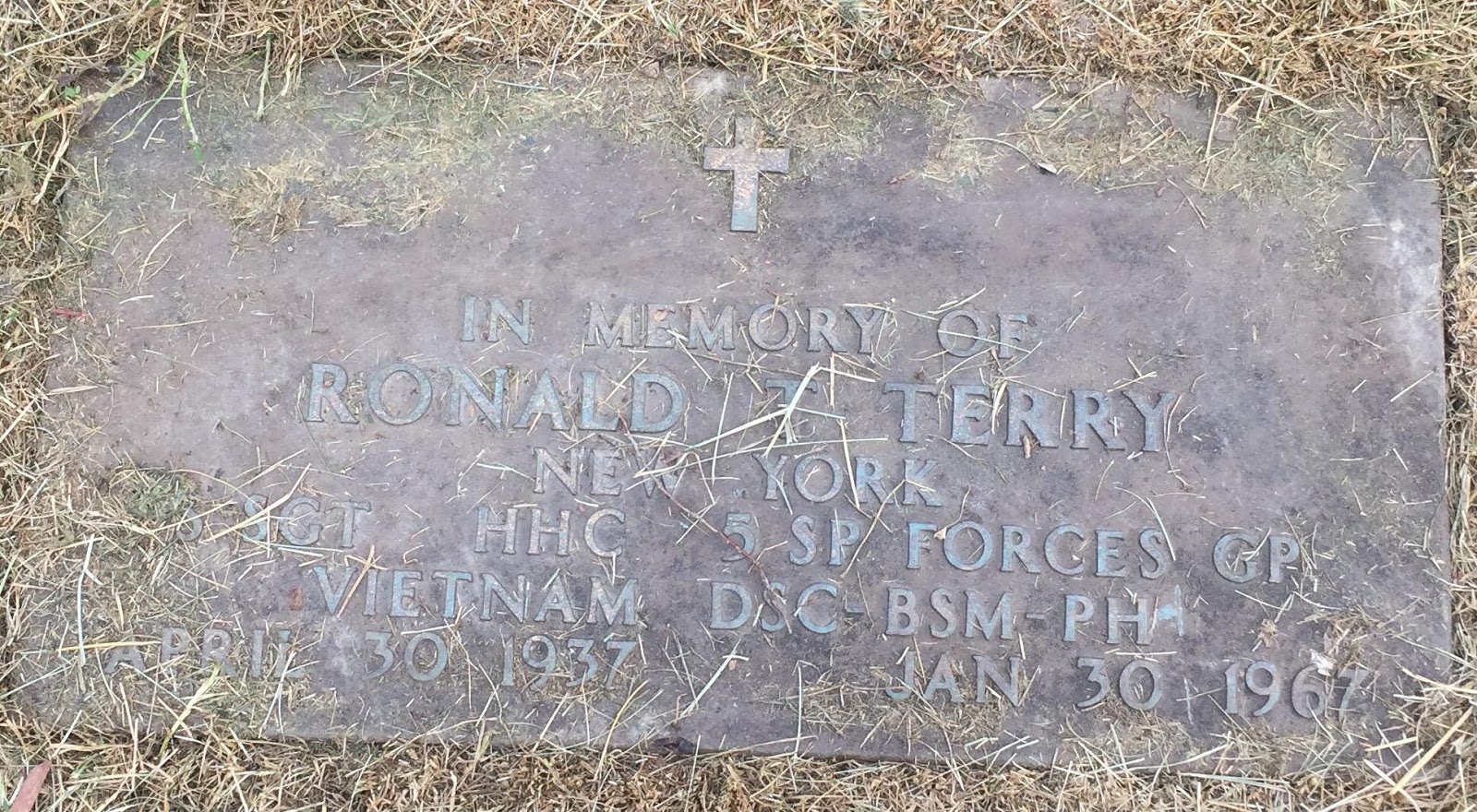
MIA (Killed/Body Not Recovered) SSG Ronald Terrance Terry was 28 years old at the time of his death. He was born and raised in Niagara Falls, NY. It is believed, according to DSC researcher Bruce Swander, that Terry was one of the few POW/MIAs to earn the DSC before capture. On 30 March 66 the U.S. Army issued General Orders Number 73, award of the Distinguished Service Cross, to Ronald Terry for action 9-14 December 1964 while serving as one of two Special Forces advisors to an eight man recon team. Several actions occurred that resulted in the DSC for extraordinary heroism in helping the wounded after multiple contacts with the enemy in this timeframe. SSG Terry has a memorial stone placed at Riverdale Cemetery, Lewiston, NY. His name is inscribed on the Courts of the Missing at the Honolulu Memorial.
(MIA) SFC Cecil Joe “Jo” Hodgson, age 28, was born and raised in Greenville, Texas. He was married to Nelda Gayne Dunn and they had five children. Cecil has a military marker in his memory at Sullivan Cemetery, Hunt County, TX and his name is on the Tablets of the Missing at the Honolulu Memorial.


Delta's mission was to support the 1st Air Calvary Division with RT's. TAOR was in the northern end of the An Lao Valley. RT's were to observe the main routes leading into the area to determine if VC or NVA were using them to reinforce or to withdraw from US Marines pushing south toward the valley and the 1st Cav and ARVN pushing north.
Intelligence was from unconfirmed agents, weather was terrible, limiting air support and communications, and it was common knowledge that bad guys controlled the valley, 1958 being the last time a friendly unit had operated in this area. Everything looking negative, Delta staff decided to brief the RT's and ask for volunteers. Three teams, 17 men total, volunteered and were infiltrated at last light, 27 January 1966. Five would be killed, three wounded and two reported MIA. The following is a list, from official sources, of those men:
TEAM One: SFC Henry A Keating; SFC Robert P Whitis; SSG Norman C Dupuis (WIA); SSG Agostino Chiariello and SSG Brooke A Bell.
TEAM Two: SFC Frank R Webber (WIA); SFC Marline C Cook (KIA); SSG Donald L Dotson (KIA); SSG Geore A Hoaglund (KIA); SFC Jesse L Hancock (KIA); and SSG Charles F Hiner (WIA).
Team Three: SFC Marcus L Huston; SSG Billy A McKeithe; SSF Wiley W. Gray; SSG Ronald T Terry (MIA); SFC Cecil Joe Hodgson (MIA) and SSG Frank N Badolati (KIA)
At 0930 on the 28th, Team One made contact resulting in 1 VC killed, 2 VC wounded, 1 American wounded (Norman C. Dupuis).
Team Three also made contact on the 28th at 0930 and again at 1205, when SSG Badolati was struck in the upper left arm by a bullet that severely mangled, and nearly severed, his arm. SFC Hodgson immediately applied a tourniquet just before the patrol broke contact. The Americans moved approximately 600 meters before stopping to treat Frank Badolati's arm. As soon as the patrol stopped, it was attacked again. The team immediately returned fire and then separated into two groups of three to attempt to evade the enemy. SFC Marcus L Huston and SSG Billy A McKeithe remained with SSG Badolati. Throughout the rest of the afternoon and night, they cared for Frank Badolati while painstakingly moving through the rugged terrain as they evaded the VC. Periodically they would stop to adjust SSG Badolati's tourniquet. When they would loosen it, the mangled arm began bleeding profusely again.
In the darkness, they came to a streambed that flowed westward from the Song An Lao River. The Americans entered the stream and used it to hide their trail. Finally SSG Badolati stated to the others that he "could not go any further" and for them to leave him behind. The other soldiers selected a position two to three feet up the bank that was well concealed with shrubs and boulders. The three men remained in place from 0300 hours to 0515 hours. During that time, both men administered medical attention to Frank Badolati's mangled arm, however, his condition continued to deteriorate. They believed he died in the early morning of 29 January 1966. After his death, they were forced to leave Frank Badolati's body hidden in the boulders and scrubs as they continued to evade the VC. Huston and McKeithe were exfiltrated by helicopter later that day.
The second group of three,SSG Wiley W Gray, SFC Cecil A Hodgson and SSG Ronald T Terry, evaded for the rest of the day (28th). On January 29, they moved at first light into a defensive position, whereupon they encountered enemy forces and another firefight ensued. Terry indicated that he had been hit, and others thought he had been killed. When they looked for Hodgson, he was gone. He was last seen with 9mm pistol in tall grass within arm’s reach of Gray and Terry, when they opened fire on a hostile element blocking their escape and became separated. Survivors heard additional shots, which they believed were shots fired at Hodgson, and they believed he also had been killed.
The team could not search for Hodgson because of the heavy enemy activity, and were forced to move to a rallying point. They evaded capture for the remainder of the day, and were ultimately picked up by helicopter. Searches for all three missing were conducted for the next 4 days with no results. Hodgson was classified Missing In Action. Badolati and Terry were classified Killed/Body Not Recovered.
Team 2 member Charles 'Chuck' Hiner tells the story of his team.
“The team was inserted into the An Lo Valley at last light on 27 January 1966. Two wet days later -- it was raining hard -- my six-man team was sitting down taking a break when we came under heavy fire from a large force of Viet Cong.
In the initial burst of fire Cook, Webber, and Hoaglund were hit, and I don't know, but I think Dotson and Hancock were hit then too. I don't know for sure because they were on flank security. When we got hit I went to the top of the hill to keep anybody from coming over the hill on top of us.
Cook (the radio man) was flank security on the left side and he couldn't get to the radio -- he was paralyzed. He called me back down and I cut the radio off him. There was a pile of rocks in the middle of this clearing so I took the radio in there and lay down on it and started calling. I called everybody and their mother who would answer. The enemy continued to fire on us.
After we got the FAC (Forward Air Controller, a Capt. Kenneth L. Kerr) on the radio and started doing our shit I started looking around. I could hear Dotson. He was hit through the chest and I could hear that death rattle. This other kid (Hancock) -- first trip in, first time on the ground, the whole nine yards -- he was dead. They had stitched him from the ankle to the top of his head. Hoaglund was more-or-less still alive. Cook lasted a long time in there but he finally died, I guess maybe about 1:00 or 2:00 o'clock that afternoon.
Webber had four bullets, all in the arm, from the first burst of fire and shortly after it started I (Hiner) was wounded when I was shot in the head by a VC firing an AK-47. The dude shot at me the same time I shot at him. I hit him first, though, and it caused him to jerk up. It (the round) went about a quarter of an inch in my scalp. It went down into the bone and just left a perfect groove.
I had called airstrikes in on top of our position to keep from getting overrun. It was either do that or get overrun so 'What the hell.’
We were fighting -- I would dare say the closest -- within 10 feet of each other. It was that tight. That's why, when I popped smoke and told the FAC to take it 360 degrees from the center of that, he said 'I can't do it because it will come in on you.' I said well it's either you or them. And that's the way it went. He didn't like it but I didn't like it either.
During a lull near the end of the battle, which lasted four hours, Hiner crawled down the slope to strip the dead -- Hoaglund, Dotson and Hancock -- of their ammo since he and Webber were almost out.
When I got back to check on Hoaglund, I found him on his back, beside a tree, with the rifle muzzle pointing toward his head. "He had one arm shot off, the other was hanging by a thread.”
During the final minutes of the battle, two reaction forces moved frantically through the thick bush toward Hiner's position. One was from the 1st Air Cav., the other, that was first on the ground, was a Reaction Force from Project Delta commanded by a Lt. Holland and led by Sgt Maj. Walt Shumate, who later became an SF legend in his role as the Sgt. Maj. for "charging"Charlie Beckwith in many SF-commands.
Statement by Don Valentine, B-52 Vet: 1st LT. Guy H. Holland was the Delta Project Recon OIC at the time. After exhausting efforts to get the 1st Cav to react to the RT's in distress, he asked for volunteers to go in and get Team Two out. 21 or so of us (don't know why that number sticks in my mind) grabbed our weapons and web gear and bailed onto 3 Hueys and headed out. There were several Nungs included in this force. And, here we go again, regarding the valor of the Nungs. I remember the one that was on my chopper, real young, and didn't have a clue as to what was going on. He only saw us running toward the choppers in a state of emergency, armed to the teeth, and he reacted the way most of them did, entering whatever lay ahead beside their American friends.
"You know when I knew I had made it?" asked Hiner, who recounted that he and Webber, down to just a few rounds between them were crouched down behind a log. "I looked up and saw Walt's bare ass coming over the top of that log. Walt told me later he was busting bush so hard and fast coming up that hill, he had busted out his pants."
KIA SFC Marlin Curtis Cook, was native of Vernon, Alabama and at the time of his loss he was a resident of Fayetteville, North Carolina. An 18 year veteran of the Army, he was 37 years old and was married with children. SFC Cook is on panel 04E, Line 106 of the Vietnam Memorial Wall in Washington D.C. His awards included a Silver Star for his actions during the attack.
“The President of the United States of America, authorized by Act of Congress, July 8, 1918 (amended by act of July 25, 1963), takes pride in presenting the Silver Star (Posthumously) to Sergeant First Class Marlin Curtis Cook (ASN: RA-14265805), United States Army, for extraordinary heroism in connection with military operations against an armed hostile force in the Republic of Vietnam. On 29 January 1966, Sergeant Cook, a member of Detachment B-52, 5th Special Forces Group (Airborne), 1st Special Forces, was part of a six-man reconnaissance team which infiltrated the northern sector of the An Lao Valley. While stopped to listen for sounds of an unusual nature, they were suddenly subjected to hostile fire from insurgents in well-fortified positions.
Despite the fact that he had been seriously wounded, SFC Cook, realizing that total annihilation was threatened, immediately began firing at insurgent positions. Unable to move because of his wounds, Sergeant Cook directed a comrade in the use of his radio and called in air strikes upon the Viet Cong positions. He continued to render support to surviving team members by continuously placing effective small arms fire on known and suspected insurgent positions. Sergeant Cook succumbed to his wounds after two hours of continuous fighting. Sergeant Cook's extraordinary heroism and gallantry in action were in keeping with the highest traditions of the United States Army and reflect great credit upon himself and the military service. “
He was the son of Mr and Mrs Marlin Cook, and father to Steven and Marlin D Cook. He is buried in Lafayette Memorial Park, Fayetteville, NC.
KIA SSG Donald Luther Dotson was 27 years old and his wife Blanche C Dotson was living in Fayetteville, NC at the time of his loss. A native of Tennessee, SSG Dotson was buried in his hometown at Sherwood Memorial Gardens, Alcoa, Blount County, TN. His name appears on the Vietnam Veterans' Memorial at Panel 4E, Line 107.
KIA SFC Jesse Leroy Hancock, 33 years old and came from El Paso, Texas. He had been married for 10 years to Miriam Marcia (Trousdale) Hancock. Jesse was buried at the Golden Gate National Cemetery, San Bruno, CA and his name appears on Panel 04E; Row: 109 on the Vietnam Veterans Memorial Wall.
KIA SSG George Appleton Hoagland III was 30 years old and from Phoenix, AZ. He was unmarried. SSG Hoagland is buried at Section 51, Site 122 of Arlington National Cemetery.
MIA (Killed/Body Not Recovered) SSG Ronald Terrance Terry was 28 years old at the time of his death. He was born and raised in Niagara Falls, NY. It is believed, according to DSC researcher Bruce Swander, that Terry was one of the few POW/MIAs to earn the DSC before capture. On 30 March 66 the U.S. Army issued General Orders Number 73, award of the Distinguished Service Cross, to Ronald Terry for action 9-14 December 1964 while serving as one of two Special Forces advisors to an eight man recon team. Several actions occurred that resulted in the DSC for extraordinary heroism in helping the wounded after multiple contacts with the enemy in this timeframe. SSG Terry has a memorial stone placed at Riverdale Cemetery, Lewiston, NY. His name is inscribed on the Courts of the Missing at the Honolulu Memorial.
(MIA) SFC Cecil Joe “Jo” Hodgson, age 28, was born and raised in Greenville, Texas. He was married to Nelda Gayne Dunn and they had five children. Cecil has a military marker in his memory at Sullivan Cemetery, Hunt County, TX and his name is on the Tablets of the Missing at the Honolulu Memorial.